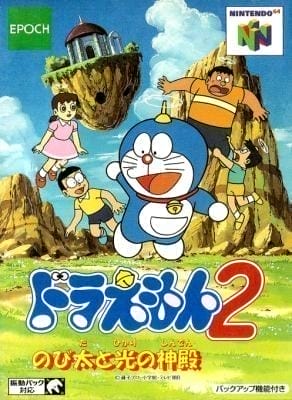
Doraemon 2: Nobita and the Temple of Light
Doraemon 2: Nobita and the Temple of Light is a 1998 action-adventure game developed by BrainSmith and published by Epoch for the Nintendo 64, released exclusively in Japan. A sharp genre shift from its platformer predecessor, it follows Nobita after a crystal he pocketed during a time-travel trip explodes with light, scattering the gang across the otherworldly realm of Cristeka. To save this land, Nobita must find his friends, recover Doraemon’s lost gadgets, and return the Light Crystal to the Temple of Light—all while navigating a real-time day-night cycle and a seven-day week of Light, Flame, Water, Wood, Wind, Rock, and Darkness.
Besturing
Over deze retro game
Doraemon 2 abandons the Banjo-Kazooie template of the first N64 game for something closer to a simplified 3D Zelda, though its execution is far more fractured. The adventure is split into two halves that rarely speak to each other. The overworld—villages, plains, forests—is a no-combat zone viewed from a distant, isometric angle. Here you talk to NPCs, solve environmental puzzles, and ferry items back and forth. Combat and platforming are quarantined inside three (originally four) dungeons, where the camera shifts behind the shoulder and the game briefly becomes the action game it wants to be.
The systems are the most distinctive part, and also the most divisive. Time flows continuously, and at 18:00 a lethal cold sets in, draining health until you sleep. The world runs on a seven-day cycle—光 (Light), 炎 (Flame), 水 (Water), 木 (Wood), 風 (Wind), 岩 (Rock), 闇 (Darkness)—rather than weekdays, and certain paths only open on specific days. A five-stage Mood (機嫌) parameter for each character modifies damage dealt and received, recovering on Light Days and degrading through neglect or injury. The Light Crystal itself is a ticking clock: its power steadily drains, and if it empties completely, the game ends.
Reviews were poor to mixed. Famitsu scored it 21/40, and critics pinpointed the overworld as bland, empty, and padded with hours of backtracking for simple fetch-quests. The dungeons, while competently designed, are short—amounting to less than an hour combined—and a fourth was cut, making the finale feel abrupt. Character-switching was restricted to story beats, and every character was stripped of unique abilities, leaving only minor weapon differences. The stiff jumping, unresponsive menus, and the absence of overworld combat turned exploration into a chore. It remains a curiosity: bolder than its predecessor in ambition, but falling flat in the space between adventure and action.
Aanbevolen op basis van je geschiedenis
Gerelateerde retrogames

Doraemon 3: Nobita's Town SOS! is een actie-avontuur voor Nintendo 64 uit 2000, ontwikkeld door Epoch. De game draait om verkenning, puzzels, gevechten en voortgang, met nadruk op 3D-platforming, Doraemon, Epoch, Nobita, Take-copter, Anywhere Door en Special.

Metroid is een actie-avontuur voor NES uit 1986, ontwikkeld door Nintendo R&D1. De game draait om verkenning, puzzels, gevechten en voortgang, met nadruk op Metroid, Nintendo R&D1, NES, Samus Aran, Zebes, Space Pirates en Revolutionary. Deze release is vooral relevant met verbeterde presentatie.

The Legend of Zelda is een actie-avontuur voor NES uit 1986, ontwikkeld door Nintendo. De game draait om verkenning, puzzels, gevechten en voortgang, met nadruk op Nintendo, As Link, Hyrule, Princess Zelda, Ganon, Introduced en Famicom Disk System.

Castlevania II: Simon's Quest is een actie-avontuur voor NES uit 1987, ontwikkeld door Konami. De game draait om verkenning, puzzels, gevechten en voortgang, met nadruk op Castlevania, Konami, RPG, Simon Belmont, Dracula en Nintendo Power.

Mitsume ga Tooru is een actie-avontuur voor NES uit 1992, ontwikkeld door TOSE. De game draait om verkenning, puzzels, gevechten en voortgang, met nadruk op Mitsume ga Tooru, TOSE en Takashi.

Super Pitfall II is een actie-avontuur voor NES uit 1991, ontwikkeld door Pony Canyon. De game draait om verkenning, puzzels, gevechten en voortgang, met nadruk op Pitfall, Pony Canyon, 1991 Famicom, NES, Japan-exclusief, Activision en Password. Deze release is vooral relevant als exclusieve versie en met verbeterde presentatie.