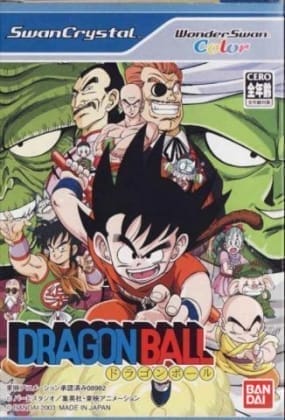
Dragon Ball
Dragon Ball is a card-based role-playing game developed by TOSE and published by Bandai, released exclusively in Japan on November 20, 2003 for the WonderSwan Color. A remake of the 1989 Famicom title Dragon Ball 3: Gokuden, it retells Goku’s journey from his first meeting with Bulma through his victory over Piccolo Junior at the 23rd Tenkaichi Budokai, using a card-driven battle system and a board-game-style overworld.
Besturing
Over deze retro game
Dragon Ball on WonderSwan Color is not a new story but a deliberate reconstruction of the game that many Japanese fans consider the definitive Dragon Ball RPG of the 8-bit era. Dragon Ball 3: Gokuden, released on the Famicom in 1989, was the third and most ambitious of Bandai’s card-based Dragon Ball games, and its structure—part board game, part turn-based card battler—was both its signature and its limitation. The WonderSwan remake keeps that skeleton intact while rebuilding the surface: sharper graphics, rearranged music, and a script that hews closer to Toriyama’s manga than the original did.
The core loop is deceptively simple. On the overworld, you select a card from your hand and move a number of spaces equal to the card’s star rating (1 through 7). Where you land determines what happens next: a battle, a training opportunity, an item, or a story event. In combat, both sides secretly commit to a number of cards, then reveal them one by one. The higher star value wins the exchange and deals damage, with the attack type—punch, kick, weapon, or a ki-based special—determined by the kanji printed on the card. It is a system that rewards hand management and risk assessment, but also one that can swing wildly on a bad draw.
Character growth is handled through four stats: Power, Toughness, Speed, and Technique. Every level-up grants five points to distribute freely, but the system is unbalanced in ways that shaped how the game is remembered. Speed governs both offense and defense in random encounters to such a degree that a speed-focused build can trivialize most fights, while ignoring Power and Technique leaves Goku’s special attacks hitting like wet paper. The WonderSwan version does address some of the original’s rougher edges—Krillin and Yamcha can now defeat Bandages the Mummy, a fight that was impossible on Famicom—but the underlying economy remains lopsided.
What makes this version worth revisiting is its treatment of the source material. The remake restores story beats the Famicom version glossed over, including Bora’s death at the hands of Mercenary Tao and a more fleshed-out Emperor Pilaf arc. It also makes strange, memorable detours: Monster Carrot has taken over Capsule Corporation, and a brief segment in Penguin Village lets you control Arale as she comically tosses General Blue across the map instead of fighting him. These changes do not always cohere, but they give the game a personality distinct from a simple port. Critical reception has been split—some retrospectives call it one of the better handheld Dragon Ball RPGs, while others find the card system too random and the balance too fragile—but it remains a fascinating artifact of how Bandai tried to translate Toriyama’s adventure into a portable, replayable format.
Aanbevolen op basis van je geschiedenis
Gerelateerde retrogames

Dragon Ball: Advanced Adventure is een beat-'em-up voor Game Boy Advance uit 2004, ontwikkeld door Dimps. De game draait om straatvechten, co-op actie en golven vijanden, met nadruk op Dragon Ball, Dimps, Goku, Combines, Emperor Pilaf Saga, King Piccolo en Krillin.

2 in 1 - Dragon Ball Z: Buu's Fury & Dragon Ball GT: Transformation is een actie-RPG voor Game Boy Advance uit 2005, ontwikkeld door Webfoot Technologies. De game draait om real-time gevechten, upgrades en verkenning, met nadruk op Dragon Ball, Webfoot Technologies, A GBA, RPG's, Buu Fury, DBZ en Transformation. Deze release is vooral relevant met verbeterde presentatie.

Dragon Ball Z: Hyper Dimension is een vechtgame voor SNES uit 1995, ontwikkeld door Bandai. De game draait om combo's, speciale aanvallen, spacing en mindgames, met nadruk op Dragon Ball, Bandai, SNES, Cell Saga, Impact System, Kamehameha en Final Flash.

Dragon Ball Z – Super Gokuden – Kakusei Hen is een RPG voor SNES uit 1995, ontwikkeld door TOSE. De game draait om verhaal, party-opbouw, gevechten en verkenning, met nadruk op Dragon Ball, TOSE, Gokuden, Kakusei Hen, RPG, Saiyan en Frieza.

Dragon Ball Z: Super Gokuden – Attack Chapter is een RPG voor SNES uit 1995, ontwikkeld door TOSE. De game draait om verhaal, party-opbouw, gevechten en verkenning, met nadruk op Dragon Ball, TOSE, A Japanse versie-exclusive RPG, Saiyan, Frieza Sagas, Super Gokuden en Z Fighters. Deze release is vooral relevant als exclusieve versie en met lokalisatiegeschiedenis.

Dragon Ball Z: Super Butōden is een vechtgame voor SNES uit 1993, ontwikkeld door TOSE. De game draait om combo's, speciale aanvallen, spacing en mindgames, met nadruk op Dragon Ball, TOSE, SNES, Saiyan, Kamehameha en Special Beam Cannon.