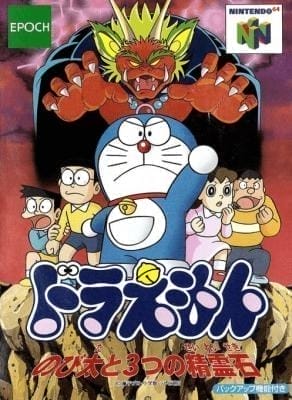
Doraemon: Nobita and the Three Fairy Spirit Stones
Doraemon: Nobita and the Three Fairy Spirit Stones is a 3D platformer developed and published by Epoch for the Nintendo 64, released exclusively in Japan on March 21, 1997. It is the first N64 game based on Fujiko F. Fujio’s Doraemon manga and the system’s first third-party 3D platformer. When the three sacred Spirit Stones shatter and the Devil escapes, Doraemon’s four-dimensional pocket is stolen, and the princess of the Fairy World is transformed into a tiny winged fairy. Doraemon and his friends must travel through the Earth, Sea, and Sky realms of the Fairy World to recover the scattered stone fragments, reclaim Doraemon’s lost gadgets, and stop the Devil.
Game Controls
About This Retro Game
Doraemon: Nobita to Mittsu no Seireiseki arrived at a moment when every 3D platformer on the N64 was measured against Super Mario 64, and it did little to hide its debts. The game opens with three crystals shattering on a hexagram, unleashing a demon upon the Fairy World. The Sky Princess is sent to the human world to retrieve Doraemon’s magic pocket, but an Evil King in bat form snatches it away, and in the chaos the pocket’s contents are scattered across three realms. By the time Doraemon and his friends follow her, she has been shrunk into a small fairy, and the only way to restore her and reseal the Devil is to rebuild the three Spirit Stones.
The structure is classic hub-and-spoke platforming. Each of the three main areas—Earth, Sea, and Sky—contains four levels. Three of those levels hide a fragment of that realm’s Spirit Stone, while the fourth is a vehicle or riding stage that changes the pace with a dinosaur, a dragon, a car, or a flying hat. Recovering a stone also frees a kidnapped king who can reassemble it. Doraemon’s lost gadgets function as progression keys, unlocking underwater breathing, flight with a toy propeller, an undersea buggy, and a rideable winged dragon, echoing the star-door structure of Mario 64.
The five main characters can be swapped at any time from the start menu, each with a different weapon or movement trait: Doraemon fires an arm cannon, Jaian sings into a karaoke microphone, Suneo boxes, Shizuka jumps highest and throws bombs, and Nobita uses a pea-shooter. A sixth bonus character becomes available after finishing the game. In practice, the character-switching mechanic is rarely required by level design, and the movement itself is stiff—characters come to a complete stop on landing, and there is only one kind of jump.
Contemporary reviews were harsh. GameSpot called it “one of the most blatant clones that the industry has ever seen” and “atrocious,” criticizing the slow, tedious gameplay and basic graphics despite some charmingly annoying elements. Later retrospectives tend to be kinder but still lukewarm: a “very bland platform game” with random-feeling levels and no reason to use Nobita over Doraemon. It remains a Japanese-exclusive curiosity—historically significant as the first Doraemon N64 title and the start of a trilogy, but remembered more for what it borrowed than for what it added.
Recommended Based on Your History
Related Retro Games
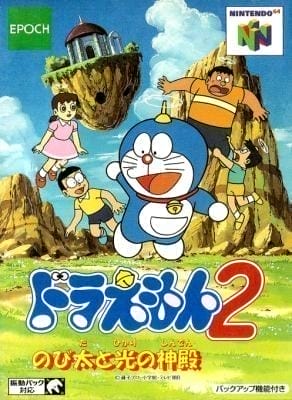
Doraemon 2: Nobita and the Temple of Light is a 1998 action-adventure game developed by BrainSmith and published by Epoch for the Nintendo 64, released exclusively in Japan. A sharp genre shift from its platformer predecessor, it follows Nobita after a crystal he pocketed during a time-travel trip explodes with light, scattering the gang across the otherworldly realm of Cristeka. To save this land, Nobita must find his friends, recover Doraemon’s lost gadgets, and return the Light Crystal to the Temple of Light—all while navigating a real-time day-night cycle and a seven-day week of Light, Flame, Water, Wood, Wind, Rock, and Darkness.

In this 3D action-adventure, Nobita must save his town from alien invaders using Doraemon's futuristic gadgets. Features open-world exploration, mini-games, and cooperative multiplayer modes.
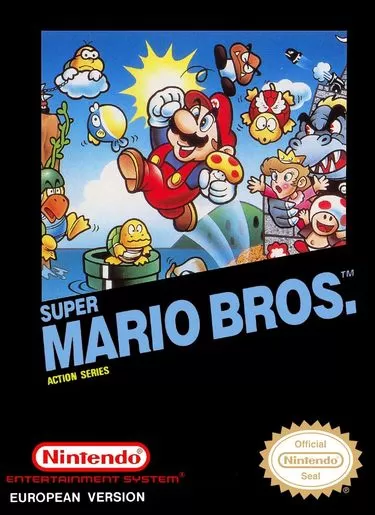
Super Mario Bros. is a platform game developed and published by Nintendo. The successor to the 1983 arcade game Mario Bros. and the first in the Super Mario series, it was released in 1985 for the Famicom in Japan. Players control Mario, or his brother Luigi in the multiplayer mode, as they travel the Mushroom Kingdom to rescue Princess Toadstool from Bowser.
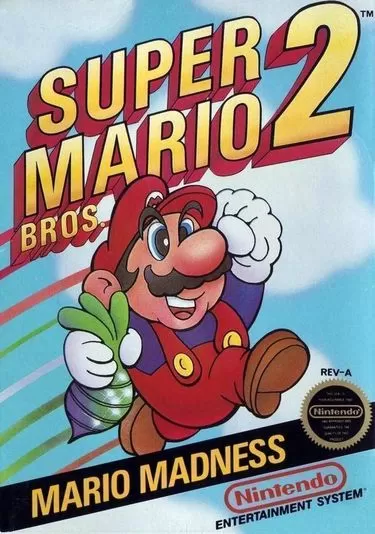
The true sequel to the original Super Mario Bros introduces new power-ups, enhanced physics, and a dynamic weather system. Mario and Luigi return with new abilities to save Princess Peach from Bowser's airship fleet across eight chaotic worlds.

The infamous 'true sequel' to Super Mario Bros. originally released only in Japan as 'Super Mario Bros. 2' for the Famicom Disk System. This brutally difficult expansion introduces poison mushrooms, backward warp zones, and deceptive wind mechanics across 32 deviously redesigned levels. Later became the 'Lost Levels' in Western compilations due to its extreme challenge.
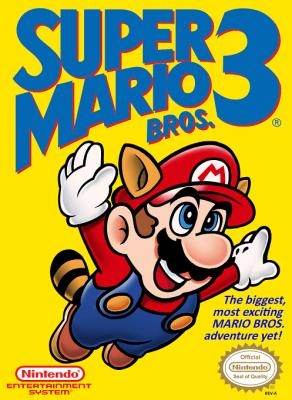
Super Mario Bros. 3 is a platform game developed and published by Nintendo for the NES. Released in 1988 in Japan and 1990 internationally, it introduced revolutionary features like the world map, diverse power-ups including the Tanooki Suit, and advanced scrolling mechanics. Often considered one of the greatest video games of all time, it set new standards for platforming gameplay and creative level design.